FibRe has gathered excellent polymer and fibre competencies to meet scientific challenges facing our industrial partners. The academic competencies and industrial needs set the framework for the research in FibRe.
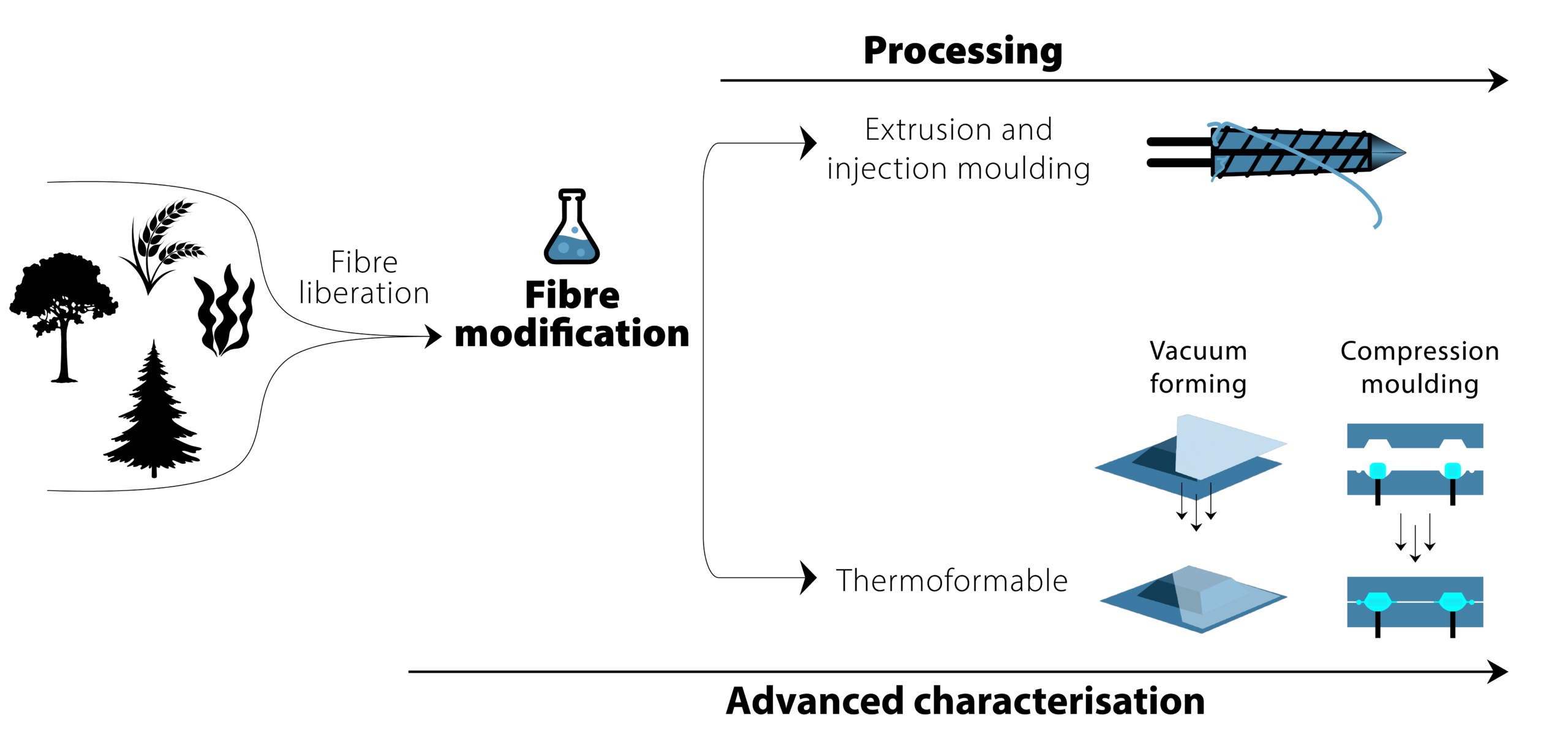
How FibRe aims to work, focusing on modification, characterisation and processing
Modification, characterisation and processing
Lignocellulosics: renewable materials with promising properties
Climate change is probably one of the biggest challenges of our time. During the last five years FibRe has worked towards the vision of replacing fossil-based thermoplastics with lignocellulose-based counterparts by generating fundamental knowledge to facilitate the replacement.
Entering Phase II of FibRe, the primary goal from the first five years, to develop lignocellulose-based materials suitable for thermoprocessing with as minimal modification as possible remains.
During Phase I, FibRe reached enhanced deformability by addition of plasticisers and modifying (cellulose-rich) fibres. Thus developed materials are so far thermoformable but not strictly thermoplastic. This progress motivates us to advance our fundamental knowledge and understanding of the structurally complex nature of lignocellulose-based materials further.
In Phase II, the planned research organisation has developed to include research and demonstrator projects. The research projects are organised in three different research tracks.
In the research tracks, methods will be developed to modify and characterise the lignocellulose-based materials with respect to chemical structure, morphology, thermoprocessability and recycling possibilities. The methodological and material knowledge generated by the fundamental research will be applied in the demonstrator projects, which aim to focus on one of the two demonstrator areas: extrusion/injection moulding or thermoforming.
FibRe mainly focuses on three fundamental research tracks and demonstrator projects.
Modification...
… to develop environmentally acceptable modification approaches to make lignocellulosic materials thermoformable.
Advanced characterisation...
… to develop methods that can elucidate the chemical and morphological structures before and after modification as well as after processing.
Processing...
…to develop thermoprocessing methods for lignocellulose-based materials and to characterise the material’s processability and recyclability.
Demonstrator projects...
…to develop demonstrators in two areas: extrusion/injection moulding and thermoforming. Moving from TRL 1 to 3-4.
FibRe is part of many strong research environments
FibRe has successfully integrated with the strong research environments at Chalmers and KTH, as well as from the other centre partners. This includes the close connection to the since-long-established Wallenberg Wood Science Center and the research infrastructure platform Treesearch, as well as national infrastructures such as the beamline ForMAX at MAX IV in Lund, and the Swedish NMR centre (also providing access to the international NMR infrastructure PANACEA).