What is FibRe?
FibRe is a Vinnova Competence Centre, which is a research consortium between academia and industry. The focus of the centre is to generate knowledge within thermoprocessable lignocellulose-based materials replace fossil-based equivalents, which will facilitate the transformation to a sustainable society.
Since FibRe's inaugeration in 2020, the centre has had at least:
FibRe's vision and goals
Working towards lignocellulose-based thermoformable materials

The FibRe competence centre is comprised of three research organisations: Chalmers, KTH Royal Institute of Technology, Chalmers Industriteknik (CIT), as well as 21 industrial partners/organisations. The industrial partners include both world-leading and early-stage companies, and cover the entire value chain for the production and usage of fibre-based materials.
Because of this broad range of partners FibRe possesses cutting-edge expertise in research areas such as polymer and fibre science, including molecular modification, advanced characterisation, and processing. This setup of competences, sourced from both academia and industry partners, is essential for tackling FibRe’s demanding tasks.
Our vision
FibRe envisions a sustainable society where thermoplastic fossil-based plastics are replaced by lignocellulose-based materials.
Our mission
Create and develop knowledge to facilitate the development of thermoprocessable lignocellulose-based materials to replace fossil-based equivalents.
The structure of FibRe
Organisation and central roles
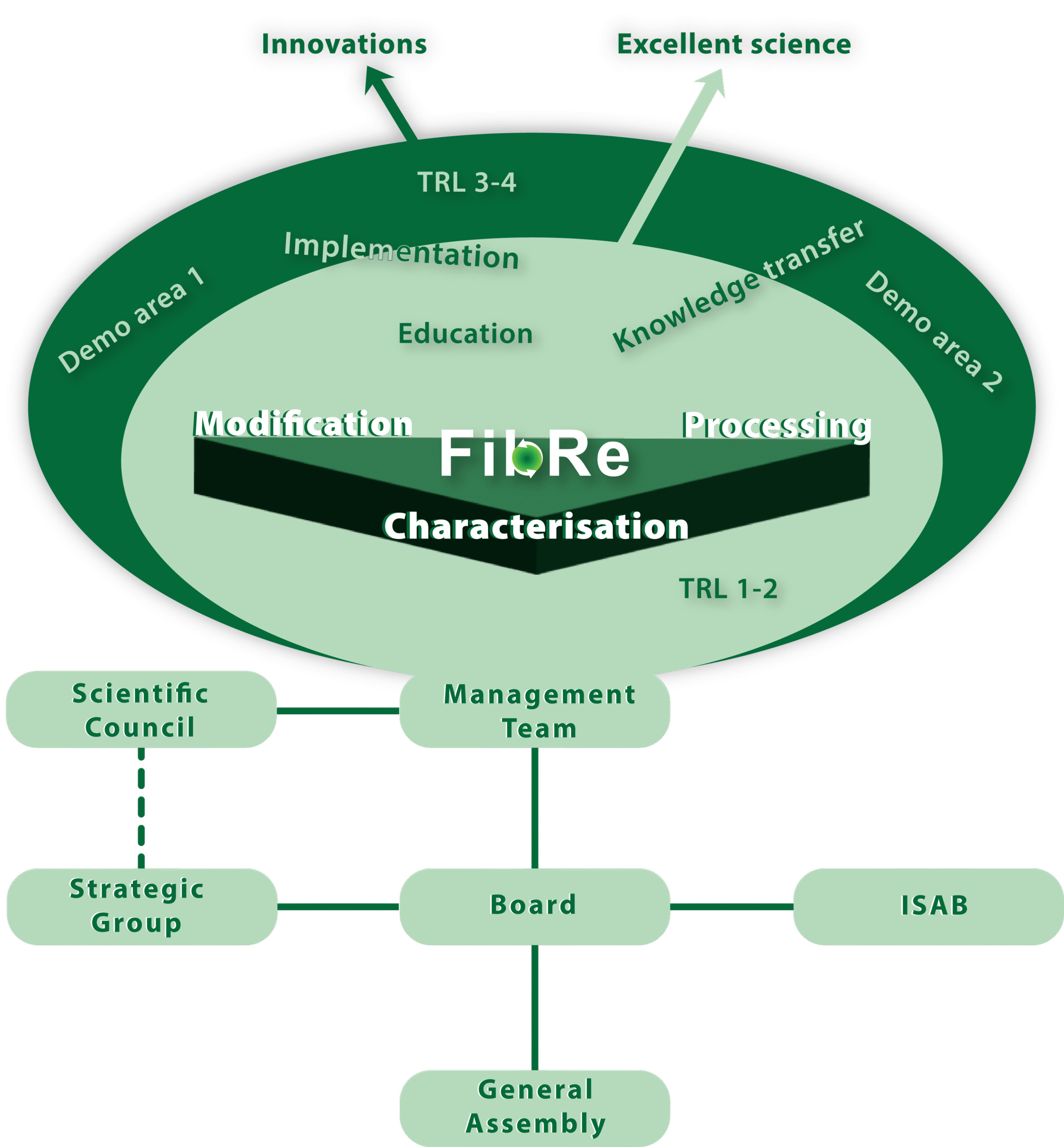
The organisation of FibRe, including its governance and overall project organisation, is illustrated in the picture to the right.
The organisation of FibRe, including its governance and overall project organisation is illustrated in the picture below.
Board
The board consists of two members from Chalmers, one from KTH and one from each core partner. The basic partners appoint two representatives to the board. The board convene 4–6 times per year and more frequently if needed. At the first general assembly, the chair of the Board, a vice chair, and the other board members are elected.
Anders Brolin, Stora Enso AB
Hanna Härelind, Chalmers tekniska högskola AB
Leif Asp, Chalmers tekniska högskola AB
Mats Johansson, KTH Royal Institute of Technology
Mats Qvarford, Tetra Pak Packaging Solutions AB
Staffan Schantz, AstraZeneca
Clara Norell, Svensk Hamapindustri AB
Johan Gising, AB Karl Hedin Bio Innovation
Management Team
The management team is led by the director and consists of the vice director (infrastructures, internationalisation and gender equality), the innovation manager, one coordinator (communication, practical organisation of centre meetings etc.), one research track leader and one financial officer.
Anette Larsson, Chalmers University of Technology
Eva Malmström, KTH Royal Institute of Technology
Philip Gillgard, Chalmers Industriteknik
Per Larsson, KTH Royal Institute of Technology
Emma Andersson, Chalmers University of Technology
Christina Sjögren, Chalmers University of Technology
Strategic Group
The strategic group consists of one representative from each core partner and basic partners, the director, vice director, innovation manager and scientific council, and the board decides upon it. It formulates and monitors centre-wide techno-economic boundary conditions, assesses scientific quality, industrial applicability and relevance of centre activities. It also assesses project proposals, provides recommendations to the board on project decisions and identifies potential needs for new projects.
Marie Bäckström, Stora Enso
Ulrica Edlund, KTH Royal Institute of Technology
Frida Iselau, AstraZeneca
Katarina Jonasson, Tetra Pak
Linda Fogelström, KTH Royal Institute of Technology
Anna Ström, Chalmers University of Technology
Carl Ternström, Woodcomposite
Sören Östlund, KTH Royal Institute of Technology
Lars Evenäs, Chalmers University of Technology
Hanna Hobohm Skoog, Axfoundation
Roland Kádár, Chalmers University of Technology
Per Larsson, KTH Royal Institute of Technology
Tomas Larsson, KTH Royal Institute of Technology
Aleksandar Matic, Chalmers University of Technology
Lars Wågberg, KTH Royal Institute of Technology
Scientific Council
The scientific council is composed of 4–6 academic experts to support the scientific developments within the centre and support research tracks’ leaders and research in research tracks and demonstrator projects. Each year, the director nominates council members, and the board takes the formal decision.
Ulrica Edlund, KTH Royal Institute of Technology
Sören Östlund, KTH Royal Institute of Technology
Roland Kádár, Chalmers University of Technology
Aleksandar Matic, Chalmers University of Technology
Lars Wågberg, KTH Royal Institute of Technology
International Scientific Advisory Board
ISAB is composed of 3–5 internationally leading researchers with different areas of expertise- The ISAB members will be appointed by FibRe’s board once the composition of the consortium is settled. ISAB supports the centre by reviewing the centre’s scientific progress, implementation activities and innovations.
Bradley Chmelka, Chemical Engineering, University of California, Santa Barbara, USA
Brigitte Voit, Division Director Macromolecular Chemistry, IPF Dresden, Germany
Thaddeus Maloney, Department of Bioproducts and Biosystems, Aalto, Finland
General Assembly
At the first general assembly, which consists of one representative from each partner, the chair of the Board, a vice chair, and the other board members are elected.